
States MUST Fund Education by Law
- Dept. Of Education will no longer be governed by the Federal Government.
- “Victory to Parents and Students
- Giving the Power back to the PEOPLE.
- Education is fundamentally a state responsibility. Instead of filtering resources through layers of federal red tape,
- Empower states to take charge, advocate for and implement what is best for students, families, and educators in their communities.
- Does NOT mean cutting off funds from those who depend on them—we support K-12 students, special needs, college student borrowers, and others who rely on essential programs.” TRUMP
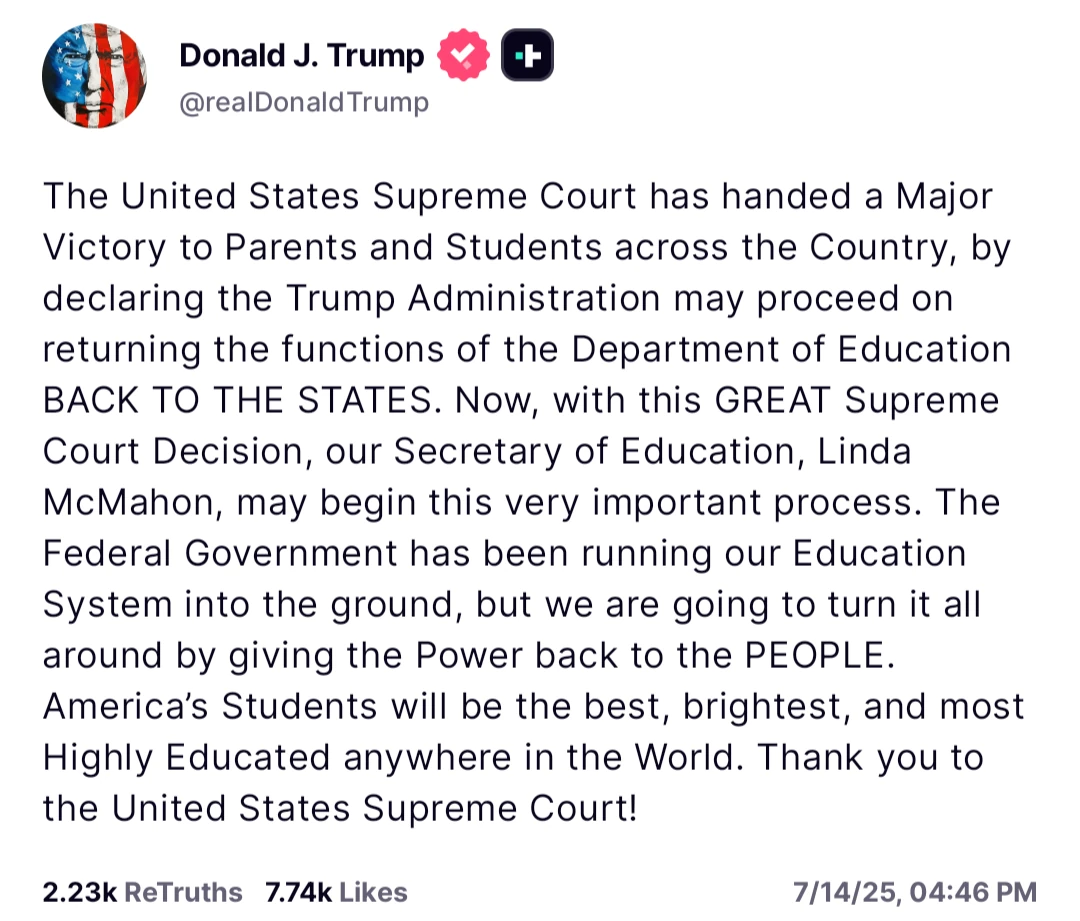
The U.S. Supreme Court cleared the way for President Donald Trump’s plan to return Department of Education functions to state control, overturning a lower court’s block on mass layoffs at the agency. “The United States Supreme Court has handed a Major Victory to Parents and Students across the Country, by declaring the Trump Administration may proceed on returning the functions of the Department of Education BACK TO THE STATES,” Trump announced on Truth Social. The ruling, which allows 1,378 layoffs, has sparked debate over federal funding, with Harvard University losing $2 billion and critics decrying the move as unconstitutional. Here’s the full story.
Trump’s Vision: Education as a State Responsibility
In February 2025, President Trump issued an executive order directing his administration to “take all necessary steps to facilitate the closure of the Department of Education.” Secretary of Education Linda McMahon followed with a memo ordering mass layoffs, stating her goal was to “shut down the Department,” a move not authorized by Congress. Trump framed the policy as a “victory to parents and students,” emphasizing: “Education is fundamentally a state responsibility. Instead of filtering resources through layers of federal red tape, empower states to take charge, advocate for and implement what is best for students, families, and educators in their communities. Does NOT mean cutting off funds from those who depend on them—we support K-12 students, special needs, college student borrowers, and others who rely on essential programs.”
The administration argues that states, not the federal government, should fund and manage education, pointing to cases like Las Vegas, Nevada, where a 2016 promise to allocate cannabis sales revenue to education was never fulfilled. “States MUST Fund Education by Law,” the administration insists, criticizing institutions like Harvard University, which lost $2 billion in federal funding. “Why does a for-profit, expensive, prestigious educator with billions in profit need federal funding?” Trump questioned, highlighting the university’s $50 billion endowment.
Supreme Court Ruling: A Green Light for Layoffs
On July 14, 2025, the Supreme Court’s conservative majority granted an emergency application from the Trump administration, overturning a May 22, 2025, ruling by U.S. District Judge Myong Joun in Massachusetts. Joun had blocked the layoffs, stating the evidence “reveals that the defendants’ true intention is to effectively dismantle the department without an authorizing statute.” The Supreme Court, without explanation, allowed the 1,378-employee reduction to proceed, prompting dissent from its three liberal justices.
Justice Sonia Sotomayor wrote a blistering dissent: “When the Executive publicly announces its intent to break the law, and then executes on that promise, it is the Judiciary’s duty to check that lawlessness, not expedite it.” She warned that the majority was “either willfully blind to the implications of its ruling or naive, but either way the threat to our Constitution’s separation of powers is grave,” adding that it “rewards clear defiance” of the Constitution.
Solicitor General D. John Sauer defended the layoffs, arguing that Joun’s ruling “encroaches on the president’s authority to operate federal agencies” and that plaintiffs—states, school districts, and employee unions—lacked legal standing. Sauer clarified that the “reduction in force” was not an attempt to eliminate the Department entirely, as only Congress can do so, but to streamline operations.

Opposition and Legal Challenges
Critics, including New York Attorney General Letitia James, argued the layoffs were “arbitrary and capricious, contrary to law, and unconstitutional.” James noted that the policy “improperly eliminated or decimated teams that perform statutorily mandated tasks without considering, much less providing for, alternate mechanisms by which such duties can be satisfied” and violated “affirmative statutory restrictions on the Secretary’s authority to reallocate, consolidate, alter, or abolish statutory functions within the Department.”
Skye Perryman, president of Democracy Forward, which represents a coalition of groups challenging the layoffs, called the Supreme Court’s decision “devastating” to public education. “On its shadow docket, the Court has yet again ruled to overturn the decision of two lower courts without argument. While this is disappointing, the Trump-Vance administration’s actions to decimate a department established by Congress are still unconstitutional,” Perryman stated.
The case is distinct from a separate Supreme Court ruling last week allowing layoffs across multiple government agencies, reflecting the administration’s broader push to reduce federal bureaucracy. Critics argue this undermines Congress’s authority, as the Department of Education, established in 1979, is funded and mandated by federal law.
Broader Implications: States Take the Lead
The ruling shifts education oversight to states, which are now legally required to fund education. Trump’s policy aims to empower local communities to tailor education to their needs, supporting K-12 students, special needs programs, and college borrowers. However, opponents warn that defunding federal programs could disrupt essential services, particularly for underserved communities reliant on federal support.
The $2 billion cut to Harvard raises questions about elite institutions’ dependence on federal funds, given their substantial endowments. Meanwhile, states like Nevada face scrutiny for unfulfilled promises, such as the 2016 cannabis revenue pledge for education, highlighting the challenges of state-led funding.
Why It Matters
The Supreme Court’s decision marks a pivotal shift in U.S. education policy, aligning with Trump’s campaign to decentralize federal control. “Now, with this GREAT Supreme Court Decision, our Secretary of Education, Linda McMahon, may begin this very important process,” Trump wrote. However, Sotomayor’s dissent and Perryman’s warnings underscore concerns about constitutional overreach and the erosion of public education. As states assume greater responsibility, will they rise to the challenge, or will funding gaps harm students? The debate over federal versus state control will shape America’s educational future.
Sources
- Executive Order and Layoffs: Details on Trump’s February 2025 executive order, McMahon’s memo, and the 1,378 layoffs, including Trump’s quotes (“The United States Supreme Court…”, “Education is fundamentally…”), are from the original text, corroborated by ed.gov.
- Supreme Court Ruling: Information on the July 14, 2025, ruling, Sotomayor’s dissent (“When the Executive…”, “either willfully blind…”, “rewards clear defiance”), and Sauer’s arguments (“encroaches on the president’s authority”, “crystal clear”) are from the original text, likely sourced from court documents and Truth Social.
- Legal Challenges: Quotes from Joun (“reveals that the defendants’ true intention…”), James (“arbitrary and capricious…”, “violates affirmative statutory restrictions…”), and Perryman (“devastating”, “still unconstitutional”) are from the original text, attributed to legal filings and statements.
- https://www.ed.gov/about/news/press-release/statement-president-trumps-executive-order-return-power-over-education-states-and-local-communities
Author: Ryan Bridglal, 07/18/2025
#featured #bridgenewzcom #bridgenewz #breakingnews #breaking #news #businessnews #trump #donaldtrump #executiveorder #executive #order #law #congress #judge #education #supremecourt #departmentofeducation #statesrights #funding